
What do OEM and ODM stand for?
> OEM stands for Original Equipment Manufacturer, referring to manufacturers who primarily handle contract manufacturing and offer high customization flexibility for products.
OEM stands for Original Equipment Manufacturer. An OEM’s business involves receiving commissions from companies to assist in product manufacturing, focusing solely on contract manufacturing without engaging in product research and development, design, marketing, or sales services. For example, Foxconn is the OEM that produces phone components for Apple. Initially, Apple handles the research and design of the phone, and then commissions Foxconn for production, allowing Foxconn to manufacture and assemble phone parts according to customer specifications. Once the products are completed, Apple brands them with its own trademark and uses a series of marketing strategies to sell the phones worldwide.
By outsourcing to an OEM, brand owners can save on the costs associated with establishing factories and manufacturing products, enabling them to concentrate more on product research, design, and brand management. Additionally, utilizing the high customization flexibility that OEMs offer allows brands to produce products that meet their specific needs.
> ODM stands for Original Design Manufacturer, which handles all aspects of product development, design, and production.
ODM stands for Original Design Manufacturer, and its business encompasses product development, design, and production. Upon receiving a commission, ODM will confirm the requirements with the brand owner and then develop and design the product based on those needs. Once the final version of the product is established, mass production begins, and the finished products are delivered to the brand owner, who is then responsible for marketing and sales. Similar to OEMs, ODM clients come from various industries, including health supplements, beauty and skincare, and electronics. For example, Samsung has previously taken on an order from Apple for the production of OLED panels, where Samsung handled the production technology, design, and supply.
By leveraging ODM’s research and development team and production expertise, brand owners can reduce product development costs. Additionally, ODMs hold the advantage of possessing product technology and formulas. This gives them a better position than OEMs in increasing contract prices and retaining clients. Furthermore, if the brand owner does not secure an agreement to buy out the technology or formulas, ODMs can apply these technologies to the orders of other clients, thereby enhancing their profit margins.
What is the difference between OEM and ODM?
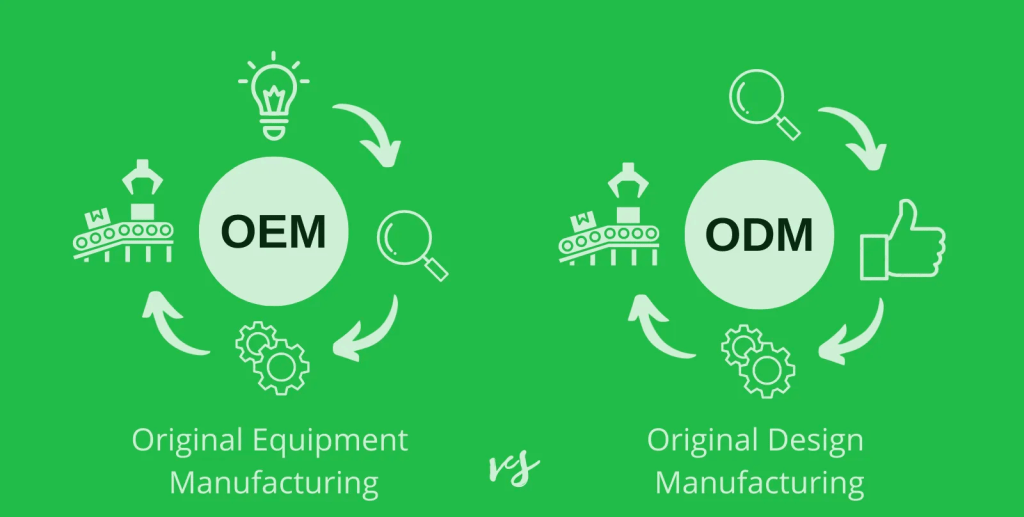
OEM is suitable for brands that possess capabilities in product research and development, design, marketing, and sales, while ODM is better for brands that want to focus entirely on marketing and product sales. The primary difference between OEM and ODM lies in the responsibilities: in OEM, you, as the client, are responsible for market research, design, and engineering. The key advantage of OEM is that you retain full control over your intellectual property (IP). Since you handle all development work, all IP rights belong to you. Before sharing any sensitive information with your chosen OEM manufacturer, ensure that you are legally protected.
Six Steps of Contract Manufacturing
The outsourcing process is detailed and complex, requiring a high level of expertise at every stage. We can fully represent you in this regard, making product development quite straightforward.
01
Confirm customer requirements
The manufacturer creates formal samples based on demand and provides them to the client for review. The client then offers feedback based on their usage experience. During this stage, the manufacturer maintains ongoing communication with the client, continuously refining product specifications through improvements in manufacturing techniques, raw material formulations, and repeated testing to gradually adjust the product to meet the client’s needs.
02
Product Sample Testing
After a series of adjustments, the client needs to confirm various elements related to product quality, such as the type of raw materials used, the formulation ratios, and the manufacturing techniques, in order to select the version that most closely meets their expectations.
03
Confirm the final version of the product.
After determining the product content, it is also essential to decide on the packaging. This can be designed by the brand itself, entrusted to other creators, or handled entirely by the manufacturer.
04
Determine product packaging
Once the product content, packaging design, and production quantities are confirmed, the mass production phase can commence according to the schedule agreed upon by both parties.
05
Put into mass production
After the mass production is completed, the manufacturer delivers the product to the brand party, who then transfers the final payment as agreed, thus concluding the transaction between both parties.
06
Product Shipment Transactions
After mass production is completed, the manufacturer will deliver the product to the brand owner, and the brand owner will remit the balance as agreed, and the two parties will reach a deal.
Which is better for your business?
Your actual situation determines which path you should take. On the one hand, working with an OEM allows you to change manufacturers at any time without losing your intellectual property rights. The only thing you need to do is to transfer the molds you currently develop to the new OEM. On the other hand, some companies, especially start-ups, feel that R&D investment is too high, and working with an ODM may be the best choice. We at Fugu group recommend that you talk to experts in the field. Usually, we will first evaluate the appropriate foundry model based on existing resources and product categories, and then further look for manufacturers. Finally, we will compare the production advantages of various manufacturers, such as product yield, process rigor, order quotation, etc., to make a favorable decision so that you can determine the right path for the future based on your specific business goals and situation.